Totalistic Cellular Automaton Generator
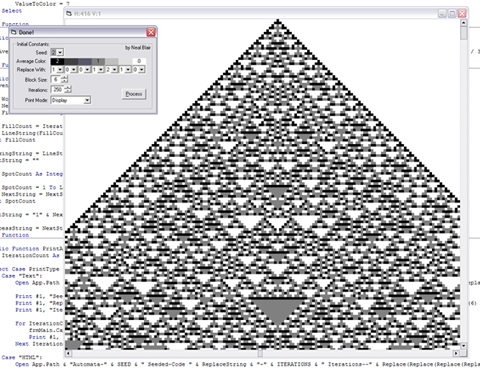
The purpose of this program is to generate highly-complex cellular automata from a simple set of user inputs. This is accomplished by analyzing a string of color blocks and generating the next line based upon the average of every block with its neighbors. This average is then changed back to a fundamental color by the rules given by the user.
Please don't forget to post comments/suggests and vote. Thanks for checking out my code.
Something I discovered after posting here... this is for those people who find mathematics interesting... if you run the program with a seed of '1' and a replacement string of '1001120' you'll generate a perfect Fibinaci Triangle. Give it a try... if you set the blocksize low, turn up the iterations, and set the print mode for 'Display' you'll get a very impressive-looking image. Be careful, though, not to generate anything too complex that your computer cannot handle it.
Assumes
I wrote this code after becoming interested in Stephen Wolfram's work on cellular automata, particularly his research in "A New Kind of Science." This code is being developed as a means of exploration into Wolfram's research.
I also decided to begin this project to experiment with graphical programming with BitBlt()--something I had never done.
Side Effects
None that I know of. A sort-of side effect would be the almost unlimited image complexity possible. An automaton generated with too many iterations and too high a detail could hang the computer for quite a while.
API DeclarationsIncluded in a module.
 (3(3 Vote))